Showing posts with label butterflies. Show all posts

Friday, July 30, 2010

On Pets and Pests

My thoughts today stem from Mo, our chicken. She was standing on my bed, looking out the window, and clucking at the butterflies.
It's an odd thing, to have a chicken on one's bed. The reason is simple: my kids fear our dog will kill Mo, and they also fret when Mo is alone for too long in her coop so bring her inside where they can keep an eye on her. They are on constant poop patrol.
Mo is short for Mohawk, because when we bought the little chick, there was a black strip of short feathers along the top of the head, just like a mohawk. The 'do has grown into a poof of feathers. Mo is a Golden Buff Polish chicken, and I have designated her female, because I don't really want a rooster, but at 8 weeks old it's a little early to tell whether Mo will cluck or crow.


Anyway, Mo was looking out the window where several Gulf Fritillary Butterflies were flitting around the Fire Bush plant. She was clucking at them because she recognized them as something yummy to eat. When I pot, I have Mo by me under the oak tree. She scratches in the dirt mainly, and eats ants I think off the gourd that climbs around the composting dirt. Once I found two wings of a Fritillary, and I think the cause of death for this lovely butterfly was Mo.
The butterflies around the Fire Bush reminded me of my upcoming nursery duty: I am to repot half of our Purple Passion Vines to 3gallon size. Yesterday I prepped the area a bit and noticed just about all the Passion Vines have caterpillars on them. A few of the vines aren't suitable to bring to market because they have lost half their leaves. So I spent some time moving caterpillars to one or two select plants, hoping they could happily share one victim and leave the others alone to grow gloriously. Meanwhile Mama Fritillaries keep coming.
So, what I may do is have Mo be a part of the food chain today. I'll keep him with me in the potting area and he can munch on caterpillars if he pleases.

Monday, July 26, 2010

Plant Highlight: Fire Bush

The Fire Bush is a great native to showcase because it can be planted in many climates, and used as a perennial or an annual.
I think of it as a home-town plant, because its northernmost point as a native is Central Florida! Go Fire Bush! But, travel farther south, even down to Central and South America, and you'll find it. If you live in other temperate regions of North America, where there are four seasons and it's not uncommon for fluffy white stuff to fall, Fire Bush is used in annual gardens. It grows very short in those regions, but the flowers are just as spectacular, and the leaves turn red before the plant dies. It does produce a fruit, and as with other annuals, you often see them next year because the plant has reseeded itself.
We offer some in the nursery - they are still pretty small. They got zapped in a freeze a couple of days after the plugs arrived and we've been coaxing them along. While little shorties, they are happy enough to start blooming.
We do have one planted in our garden bed in front of the house. It dies back in the winter time (we are Zone 9A - I think Zones 10 and 11 keep a year-round bush) and comes back with a flourish. It is quite large - about 6-7 feet tall, and very wide - I'd say 4 feet. Everything loves the Fire Bush! One year we had seven garden spiders (the Charlotte's Web kind, that 'write' in the web). We get Ruby Throated Hummingbirds, black racer snakes, and so many different kinds of butterflies. Sulphurs, skippers, swallowtails, fritallaries... wasps and bees too. It likes full sun and is pretty drought tolerant, another nice feature of a Florida garden plant.
Other names you may hear for the Fire Bush are Scarlet Bush and Hummingbird Bush.


Thursday, July 8, 2010

Our Neck of the Woods


Look at a map of Florida and find the center of the state with your eye. Chances are, you've landed pretty close to Lake Wales.

We've been here four years. I had visited Florida before, and my impression was a lot of sand, concrete, and of course, the beaches. And it was flat. But Lake Wales, while it has a lot of sand, has some really fun hills. I wish it snowed so I could go sledding down one. That probably won't happen.

Lake Wales is just one town on the Ridge, a section of land, like a spine, that trails down the state. Back in prehistoric times, this was the only part of Florida that stuck out of the water. The sand and hills come from ancient dunes. Fossil hunting is a popular past time here.

We are also in an ecosystem called the Scrub Palm Desert. That means more sand. We have some creatures that you only find around here, which makes us special, unique and often endangered.

Ridge Plant Nursery is out in the boonies of town, with sand roads (there's that sand reference again)and we have great nature. I've seen Scrub Jays, Glass Lizards, Indigo Snakes and Gopher Tortoises roaming around when we go for walks.

So we are in a neat place. We've become sensitive to what we share the land with and what we do with it.

Top Photo: That's our garden bed. Jim refers to it as the propagation garden.
Middle: We have some Swallowtail Caterpillars munching on the Fennel and Parsley.
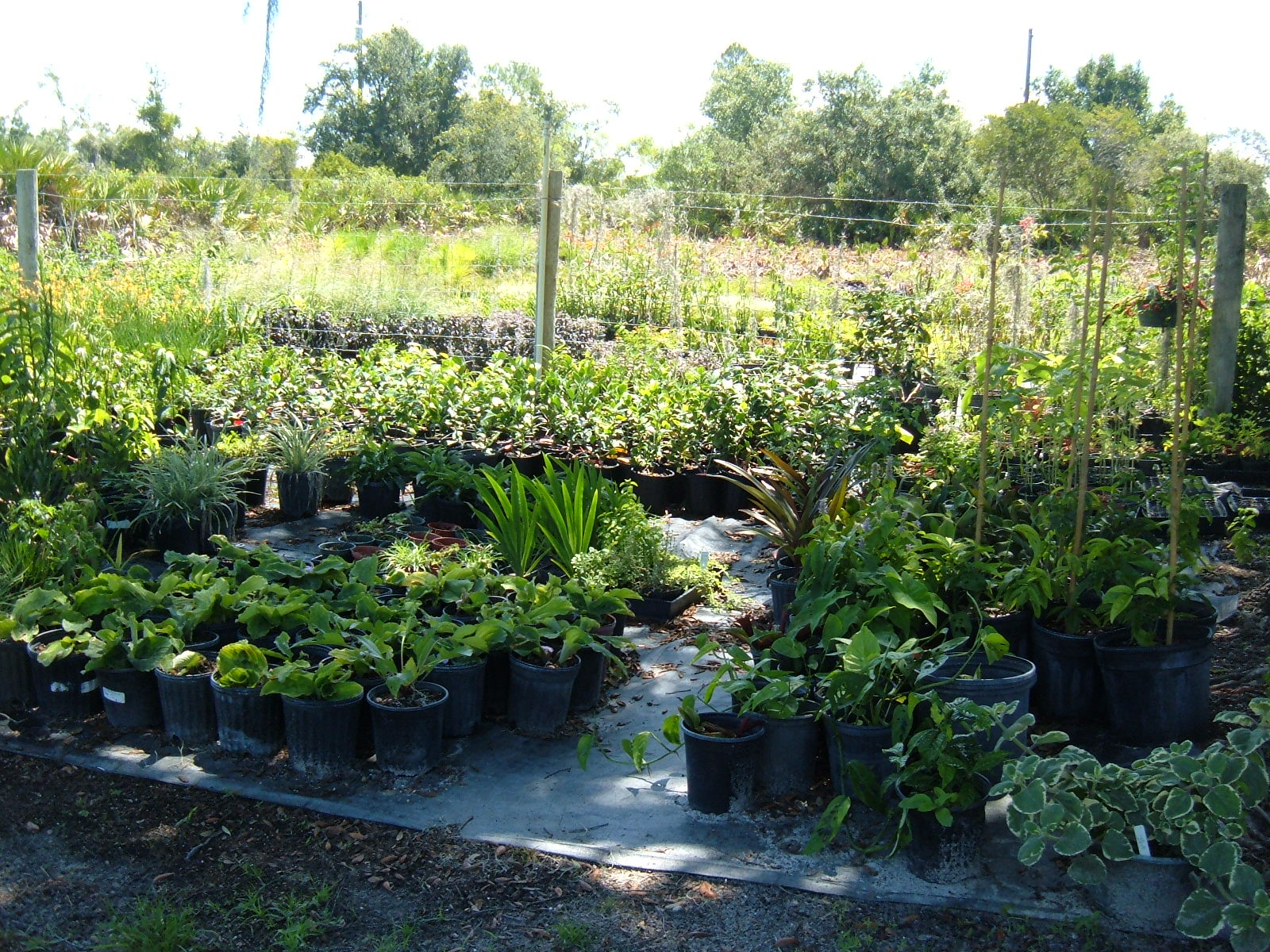
Bottom: Just one view of the shade area (thank you, live oak for providing that). You can see the scrub palm field in the distance.

Thanks for taking a peek. I'll share more about what we grow and do next time!